Published: Jun 30, 2026 by Daning Huang
Accurate prediction of complex dynamical systems from noisy measurements remains a significant challenge in scientific computing. Kernel ridge regression learning strategies are often effective when applied to clean data, but have limited success with noisy data. Recent work has observed that a weak formulation can act to filter noisy data, and different learning strategies have achieved increased noise robustness with a weak-form framework.
Our work gives an overview of the filtering mechanism behind the weak formulation and provides a bias-variance error decomposition. Using these insights, we combine a weak formulation with a kernel learning strategy to propose Weak-form Kernel Ridge Regression (WKRR) for learning dynamical systems. The proposed framework is simple to implement, effective for both clean and noisy data, and outperforms several baseline methods. We demonstrate the performance of WKRR on chaotic benchmark systems in up to 64 dimensions, as well as 15,000-dimensional real-world fluid data.
This work is supported by NSF CDSE Program.
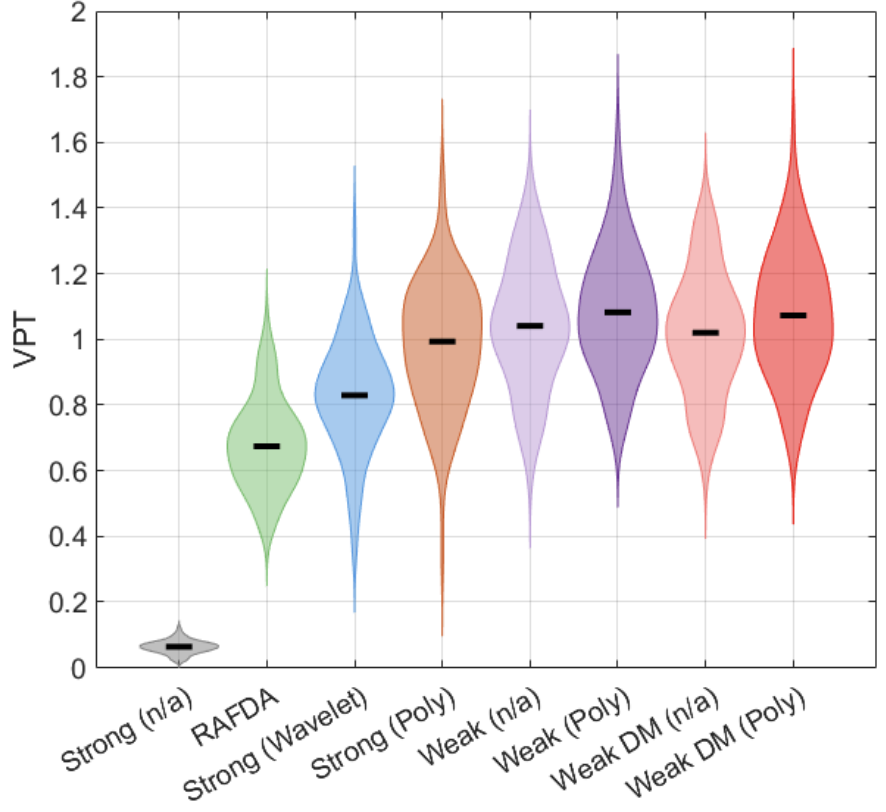
[Figure: VPT=”Valid Prediction Time”, the longer the better; with noise, regular method (strong) fails badly; state-of-the-art (RAFDA) is OK but expensive; ours (all the rest) are better and faster.]