Published: Aug 10, 2026 by Daning Huang
In the past two years, we have been working on the kernel methods, esp. the diffusion maps (DM) kernel (see, e.g., ICLR spotlight, DM for dynamics, and weak form KRR). The methods themselves are surprisingly simple, but effectively in learning dynamics from data, even for chaotic and high-dimensional problems.
Hence we are now trying to understand why DM kernel is so effective. As the first step, in our recent paper, we try to characterize what DM kernel represents in a manifold setting. Specifically, we prove that the DM kernel converges uniformly to the heat kernel on the manifold (assuming uniformly sampled data on manifold, sufficient dataset size, sufficiently large time, and kernel bandwidth scaled appropriately). Then we further demonstrate the greater expressiveness of the DM kernel compared to the Gaussian kernel for supervised learning over a larger class of functions on manifolds with boundary.
This work is supported by NSF CDSE Program.
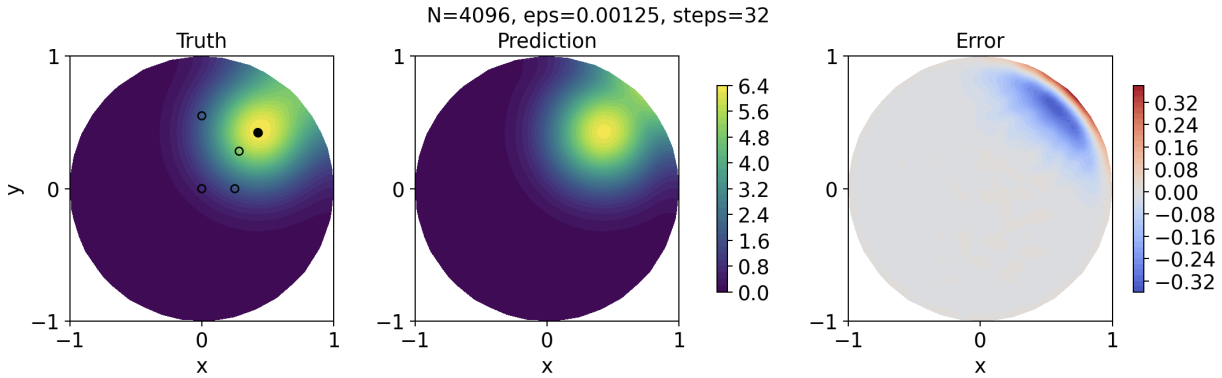 [Estimation of heat kernel by DM on a unit disk]